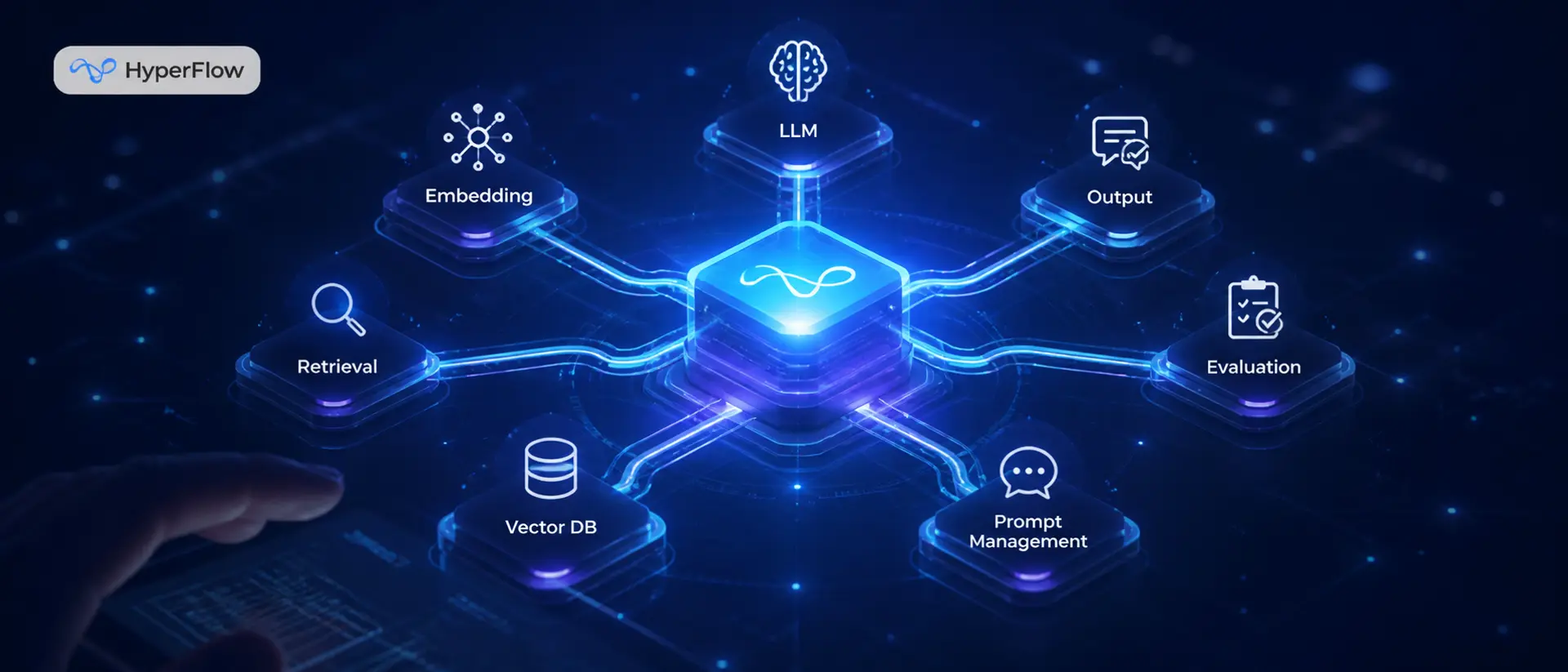
HyperFlow AI’s Super Node
Introducing HyperFlow’s role-based architecture, designed to keep the core structure of workflows stable even as the AI environment continues to change.
Flexible AI Workflows Enabled by the Super Node Architecture
In generative AI application development, the key is not simply connecting multiple services. What matters more is designing the workflow so that its core structure remains stable even as the AI environment continues to change. To achieve this, HyperFlow AI has adopted a role-based Super Node architecture instead of a service-centered node structure.
The Most Common Problem in AI Development
Generative AI technology is changing extremely quickly. A model that seemed like the best choice yesterday may become more expensive today, a better alternative model may appear, or a specific API policy may change. These situations are no longer rare.
For example, even when building a single AI chatbot, many different components are required internally.
LLM model
Embedding model
Vector database
Document retrieval logic
Prompt templates
Output format control
Cost and performance management
User input processing
The problem arises when each of these elements is tightly coupled to a specific service. A system may initially be built around OpenAI, but later the team may want to switch to Claude or Gemini. A certain vector database may be used at first, but due to cost or performance issues, migration to another database may become necessary.
In traditional approaches, these changes do not end as simple replacements. The entire codebase must be modified, the data flow must be adjusted again, and exception handling and testing must be repeated. As a result, maintaining and improving an AI app often becomes more difficult than building it in the first place.
The Limitations of Traditional Node-Based Structures
In general workflow tools, each service is provided as a separate node. For example, nodes are typically organized by service names such as OpenAI, Google Sheets, Slack, or Notion.
This approach is convenient for simple automation. However, it has clear limitations when applied to generative AI application development.
When the service changes, the node changes.
When the node changes, the input and output structures also change.
Eventually, the entire flow often needs to be modified again.
In other words, the center of the workflow becomes not “what we want to do,” but “which service we use.”
HyperFlow AI approaches this differently. In an AI workflow, what matters is not the name of a specific service, but the role that the node performs.
What Is HyperFlow’s Super Node?
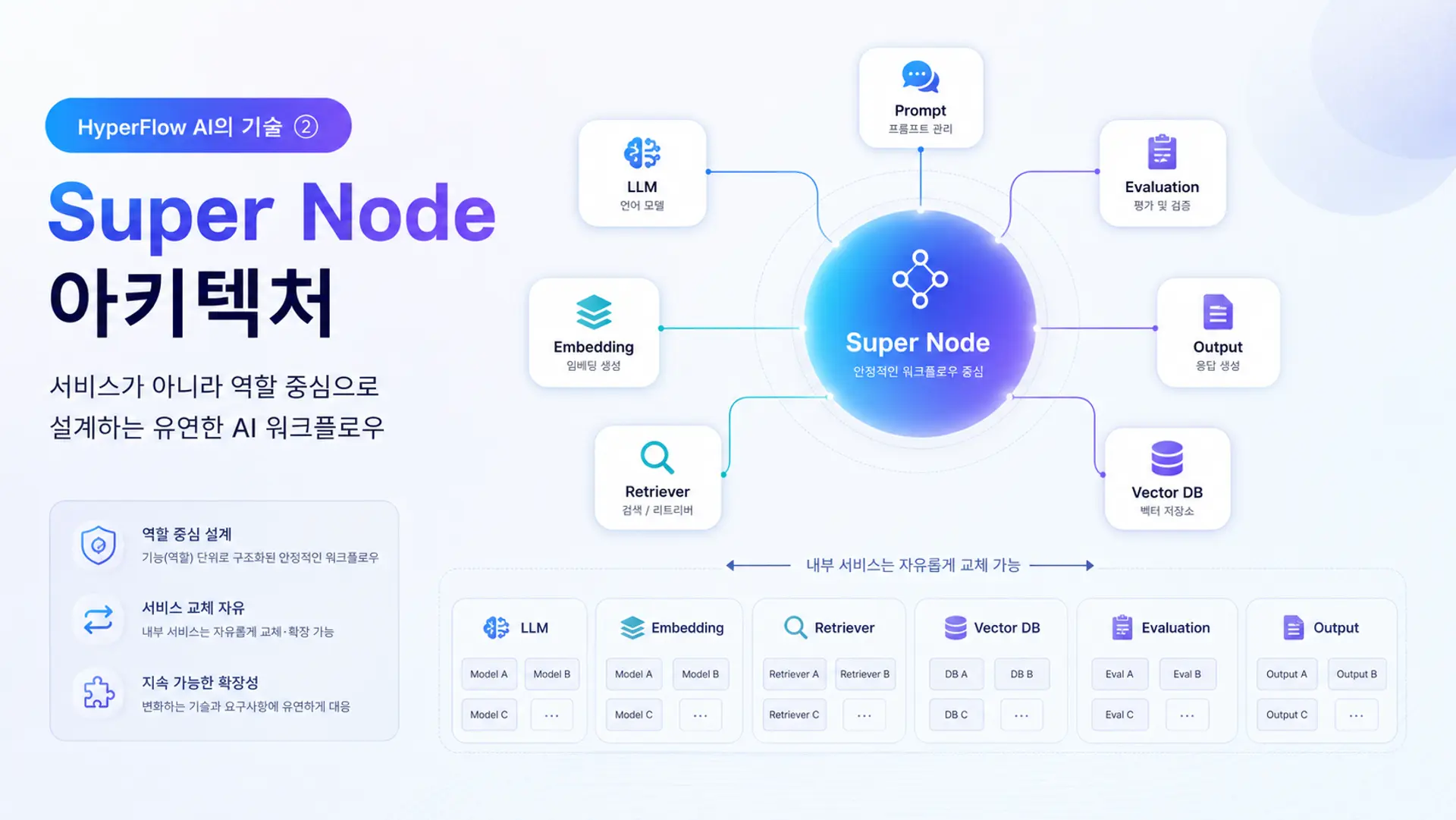
HyperFlow’s Super Node is not a node tied to one specific service. Instead, it is an abstracted node designed around a single functional role.
For example, suppose a user wants to perform the task of “calling an LLM.” In a traditional approach, OpenAI, Claude, and Gemini nodes may each exist separately. In HyperFlow, however, all of them can be treated as one LLM role.
Users can keep the structure of the flow intact while simply selecting or replacing which model to use internally.
From OpenAI to Claude
From Claude to Gemini
From commercial models to open-source models
Even if the model changes, the overall structure of the workflow remains the same. This is the core idea of the Super Node architecture.
Designing Around Roles, Not Services
The biggest advantage of the Super Node is that it makes workflows more sustainable over time. In an AI development environment, no single tool or model can remain the best choice forever. Depending on cost, speed, performance, security policies, and customer requirements, the right option may change at any time.
That is why HyperFlow AI chose a role-based structure from the beginning, rather than a structure dependent on a specific vendor.
LLM calls
Document retrieval
Embedding generation
Data preprocessing
Conditional branching
Result evaluation
Output generation
These tasks are concepts that last much longer than the names of specific services. HyperFlow structures workflows around these functional roles and connects the necessary services and models at the execution stage.
As a result, even if users change internal components in response to technological shifts, they do not need to rebuild the entire flow from scratch.
A Structure That Makes AI Experimentation and Operations Faster
The Super Node also provides strong advantages during experimentation. A generative AI application is not a system that is built once and left unchanged. The process of changing prompts, switching models, adjusting retrieval methods, and refining output formats continues repeatedly.
In traditional approaches, each of these experiments was close to a development task. To change a model, developers had to modify code. To change the retrieval structure, they had to reconnect the pipeline.
With HyperFlow, however, users can quickly compare various configurations within the same flow through Super Nodes.
Which LLM is more suitable
Which embedding model produces better search results
Which prompt structure creates more stable responses
Which parameter combination offers the best balance between cost and performance
These experiments can be carried out by changing flow settings instead of modifying code. This turns AI development into a faster, more repeatable, and more systematic process.
Workflows That Become Technical Assets
What HyperFlow AI values is not simple automation. What matters is that the workflows we create can become technical assets that continue to be used over time.
AI models may change.
API prices may change.
Customer requirements may change.
But the structure of work and the way problems are solved do not disappear easily.
The Super Node architecture places this stable structure at the center and allows changing technical elements to be replaced flexibly. Through this, AI workflows built in HyperFlow become not just one-time implementations, but operational IP accumulated within the company.
The Development Approach HyperFlow AI Pursues
The goal of HyperFlow AI is not to make users write more code. Rather, it is to structure complex technical elements so that users can focus on solving the essential problem.
What data should be used?
What decision flow should be designed?
What output should be generated?
How should the result be verified and improved?
HyperFlow provides an environment where users can focus on these questions. The Super Node is the core structure that makes this possible.
In the era of generative AI, simply connecting AI tools is not enough. What matters is creating a structure that can be continuously improved and operated even as the technology environment changes.
HyperFlow AI’s Super Node architecture makes that structure possible. Making AI applications easier to build, faster to experiment with, and longer-lasting in operation — this is the core challenge that HyperFlow aims to solve through the Super Node.